 Hinweis:










 more
moreRelated Products
 Print this Page (PDF)
 Request an Offer
 Ask a Question
 Comment this Page
Personal Contact
Dr. Joachim SacherCEO
t.: +49 6421 305-0
f.: +49 6421 305-299
DBR Diode Lasers, Single Mode
Single ModeDescription:
DBR Lasers, 760nm .. 1083nm, single mode, narrow linewidth with good side mode suppression. Single mode emission is ensured via a Bragg grating. Check our stock list for availability.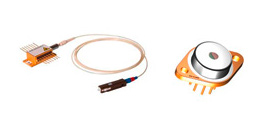
Distributed Bragg Reflector (DBR):
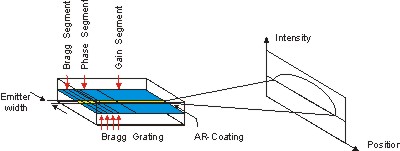
Distributed Bragg Reflector (DBR) Diode Lasers are tunable single mode diode lasers. Typical geometrical sizes of the laser chip are 1000µm x 500µm x 200µm (length x width x height). The laser chip is grown by MOVPE of compound semiconductor material. The optical gain is provided by double heterostructure which include several Quantum Wells for electronic confinement. Typcal emitter width range between 3µm and 7µm. The single mode emission is enforced by a Bragg grating with the laser chip. The surfaces of the laser chip act as cavity mirrors due to the difference of the refractive index of the laser material and the surrounding air. The rear facet of the laser chip is provided with a high reflection coating. The emission wavelength of the DBR laser is tuned by a synchronized changing the current of the Bragg and the Phase segment of the laser. Distributed Bragg Reflector (DBR) Diode Lasers are available with up to 100mW at 1063nm and 80mW at 1083nm. These diode lasers are longitudinally and spatially single mode. They can be tuned up to 100GHz mode-hop free. Please check our data sheets.
Packaging Options:
DBR Lasers are available in 9mm TO-cans, TO3 cans with an integrated thermoelectric cooler or butterfly packages with thermoelectric cooler and single mode fiber coupling. Please note that the output power is reduced to typically 20% of the nominal power for the fiber coupled butterfly versions.
| More Details | Wavelength | Power | Tuning (total) | Mount | |||||
|---|---|---|---|---|---|---|---|---|---|
| DBR-0760-020 | 760nm | 20mW | 2nm | TO8 | |||||
| DBR-0767-040 | 767nm | 40mW | 2nm | TO8 | |||||
| DBR-0767-060 | 767nm | 60mW | 2nm | TO8 | |||||
| DBR-0770-040 | 770nm | 40mW | 2nm | TO8 | |||||
| DBR-0770-060 | 770nm | 60mW | 2nm | TO8 | |||||
| DBR-0780-080 | 780nm | 80mW | 2nm | TO8 | |||||
| DBR-0780-120 | 780nm | 120mW | 2nm | TO8 | |||||
| DBR-0785-080 | 785nm | 80mW | 2nm | TO8 | |||||
| DBR-0795-080 | 795nm | 80mW | 2nm | TO8 | |||||
| DBR-0795-120 | 795nm | 120mW | 2nm | TO8 | |||||
| DBR-0852-080 | 852nm | 80mW | 2nm | TO8 | |||||
| DBR-0852-120 | 852nm | 80mW | 2nm | TO8 | |||||
| DBR-0895-080 | 895nm | 80mW | 2nm | TO8 | |||||
| DBR-0895-120 | 895nm | 120mW | 2nm | TO8 | |||||
| DBR-0976-120 | 976nm | 120mW | 2nm | TO8 | |||||
| DBR-0976-200 | 976nm | 200mW | 2nm | TO8 | |||||
| DBR-1064-120 | 1064nm | 120mW | 2nm | TO8 | |||||
| DBR-1064-200 | 1064nm | 200mW | 2nm | TO8 | |||||
| DBR-1083-120 | 1083nm | 120mW | 2nm | TO8 | |||||
• Caesium Spectroscopy - D2 Line
• Rubidium Spectroscopy - D1 Line
• Rubidium Spectroscopy - D2 Line
Brochures
- Diode Lasers (DFB)Distributed Feedback Lasers
Technical Drawings
- Technical Drawing - G2Laser Carrier: G2
- Technical Drawing - TO3Laser Carrier: TO3
- Technical Drawing - TOC3Laser Carrier: TO3 with Peltier Cooler
Technical Documents
- Technical Note – No. 01Diode Laser - Principles of Operation
- Technical Note – No. 09Tunable Lasers - Littman/Metcalf vs. Littrow vs. DFB - Selection Guide
- Technical Note – No. 12High Frequency Tuning of 1063nm and 1083nm DBR Diode Lasers (Tuning Behavior)
- Technical Note – No. 36Concepts for DFB Lasers








